Only buy when actor-led ad variation is the bottleneck you are ready to test.
A paid test is reasonable when
- You already have a product, offer, landing page, and ad script.
- You need multiple actor reads faster than sourcing human creators.
- You can judge the output against a real campaign acceptance checklist.
- You are comfortable treating the first month as a controlled production test.
Do not start here when
- You need a free trial before entering payment details.
- You expect the first generation to be automatically publishable.
- You have not read the credit, rollover, cancellation, and refund terms.
- Your main need is product URL import, localization, or broad business video.
If the positive case fits, use Starter and run one brief before upgrading. If it does not fit, compare Creatify for ecommerce ads or HeyGen for broader avatar video before clicking an Arcads checkout CTA.
What most buyers need to know before opening checkout.
Does Arcads have a free trial?
The logged-in monthly paywall we captured did not show a permanent free plan. Treat Arcads as a paid evaluation unless the current checkout presents a different trial or account-specific offer.
Which Arcads plan should a first-time buyer choose?
Starter is the rational first plan for one controlled actor-led ad test. Creator and Pro only make sense after real output volume or specific workflow features justify the higher monthly cost.
Can you get an Arcads refund after generating?
Normally not for creative dissatisfaction. The published policy ties a billing-period cash refund to a request within 30 days and zero credits used; confirmed failures may receive credit reimbursement instead.
Four checkpoints determine whether Arcads is worth paying for.
Attributed walkthrough stills let us inspect the parts of the workflow that affect a buying decision: audience fit, delivery control, product visibility, and the moment credits are committed. They document the interface shown in a creator account; they are not presented as our own paid benchmark or proof of final output quality.
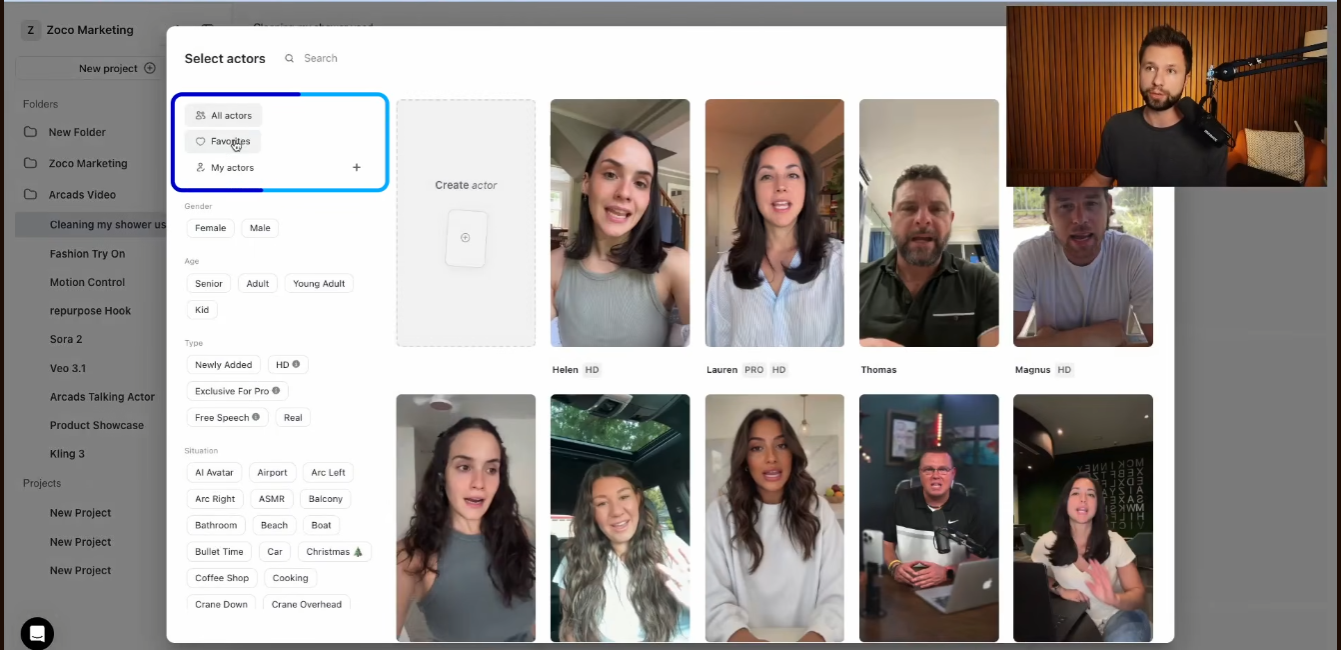
The library can be narrowed before generation. The visible filters cover gender, age, actor type, and filming situation, making the first shortlist more deliberate than scrolling through faces.
Creator walkthrough stillActor fit is the first variable you are paying to test.
The practical advantage is not the headline library size. It is the ability to hold the offer and script constant while changing the presenter, demographic, and filming context.
- Filter for the intended buyer before choosing a face.
- Shortlist several plausible actors instead of one favorite.
- Judge the batch by usable rate, not by its best-looking frame.
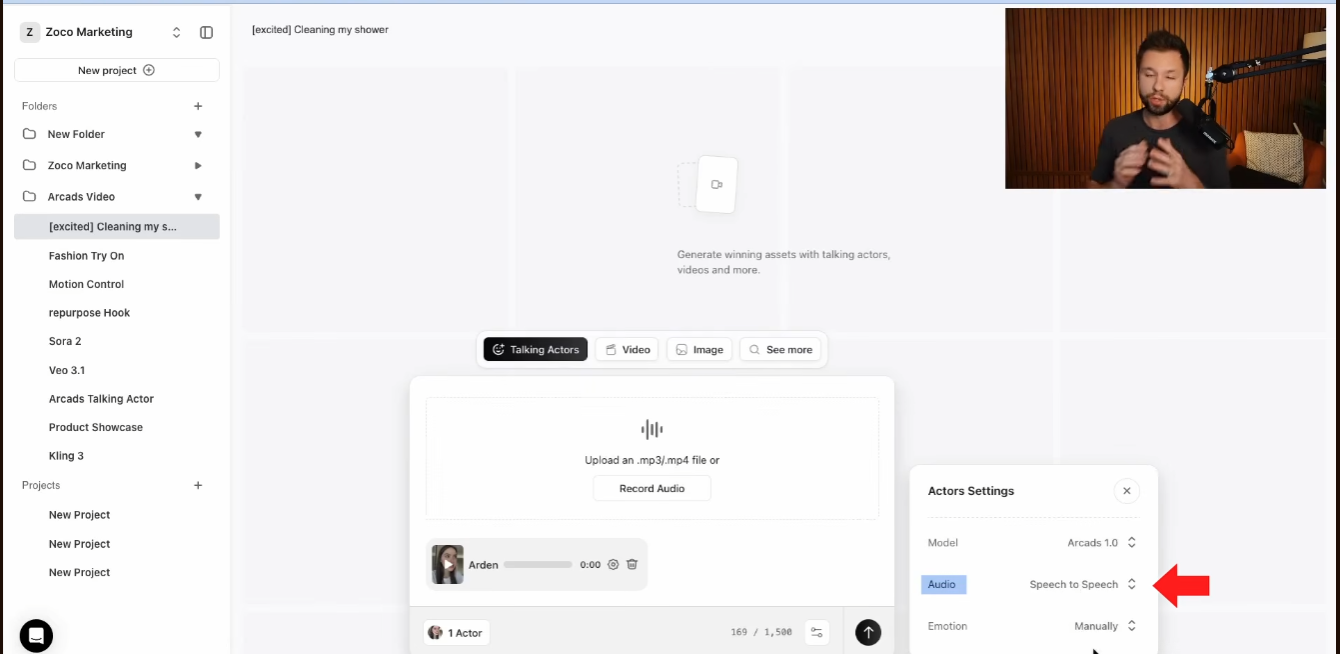
Control delivery, not only the words
The Talking Actor screen includes a Speech to Speech input with upload and recording controls. This can carry intended rhythm and emphasis into the generation, but clean source audio and output review are still required.
Inspect the setting near 03:12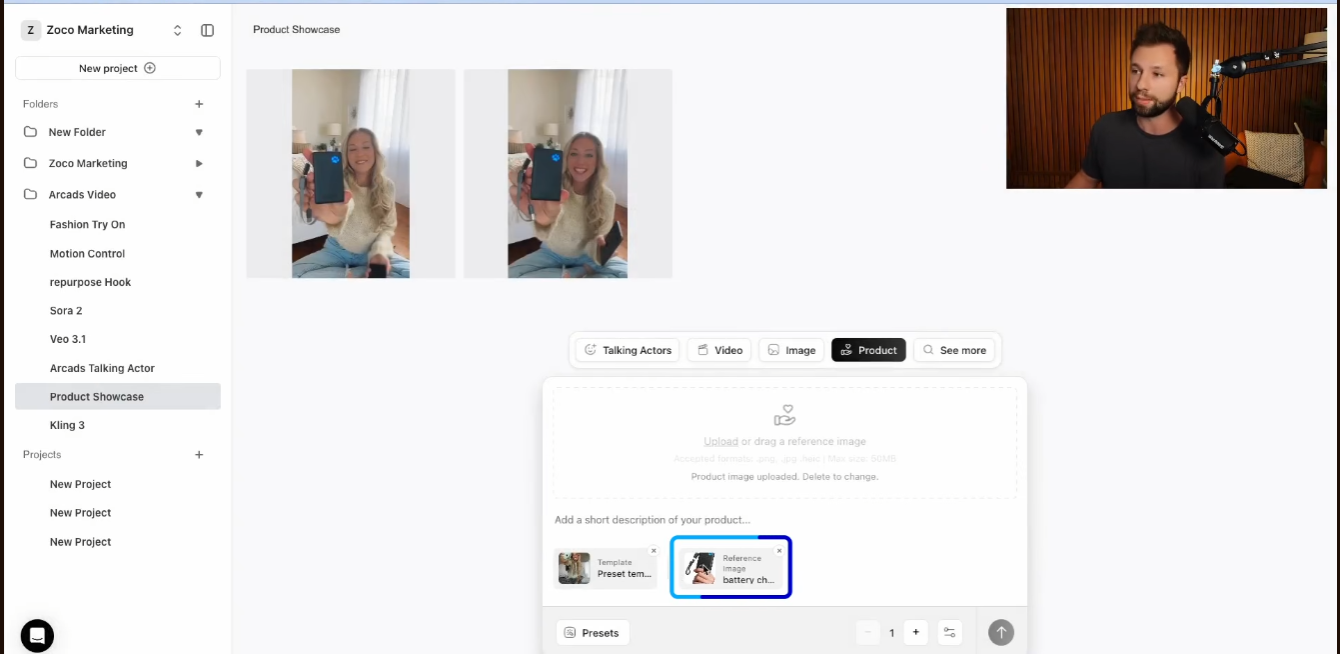
Show the product instead of only describing it
Product Showcase accepts a reference image and pairs it with a preset scene. That is useful for visual product moments, but it is not the same as importing a product URL or guaranteeing packshot accuracy.
Inspect Product Showcase near 06:12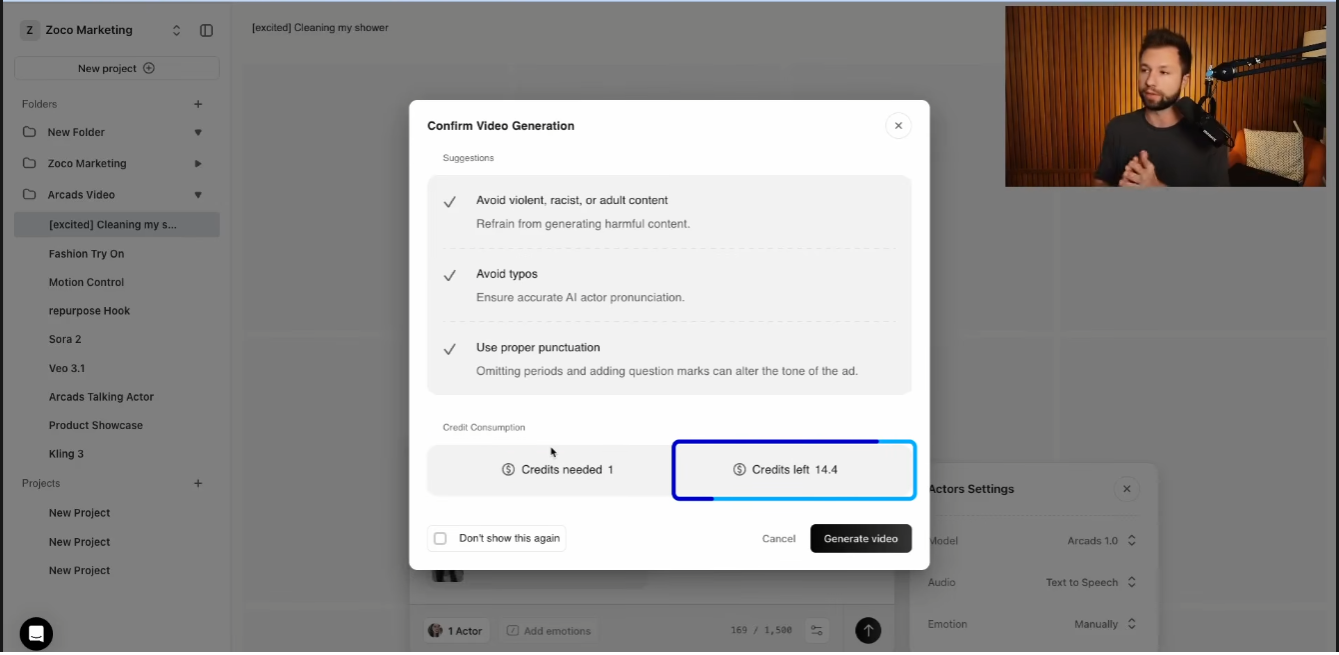
There is a checkpoint before credits are committed
The walkthrough shows a confirmation dialog before generation. Its legacy or creator-account unit reads 1 credit; it does not match the current paywall's 8,000-credit accounting. We use this frame only to verify the confirmation step, never to estimate today's cost per video.
Verify the checkpoint near 03:37They do not establish lip-sync quality, hand accuracy, product fidelity, a typical usable-output rate, or campaign return. Those questions still require a small same-script test with rejected generations counted.
One agency used the same script across seven actor variants.
Christian Sonic shows an ad-account workflow and reports the following outcome from his own agency campaign. These are self-reported results from one offer and are not an Arcads benchmark, typical result, or independently audited case study.
Arcads can make actor variation cheap enough to test. The actionable method is to preserve the offer and script while changing one visible variable.
The video does not provide an audited attribution window, equal spend per creative, lead quality, revenue, or a controlled non-Arcads baseline. One variant receiving 11 calls may also reflect delivery allocation.
Both billing views matter because the captured promotions conflict.
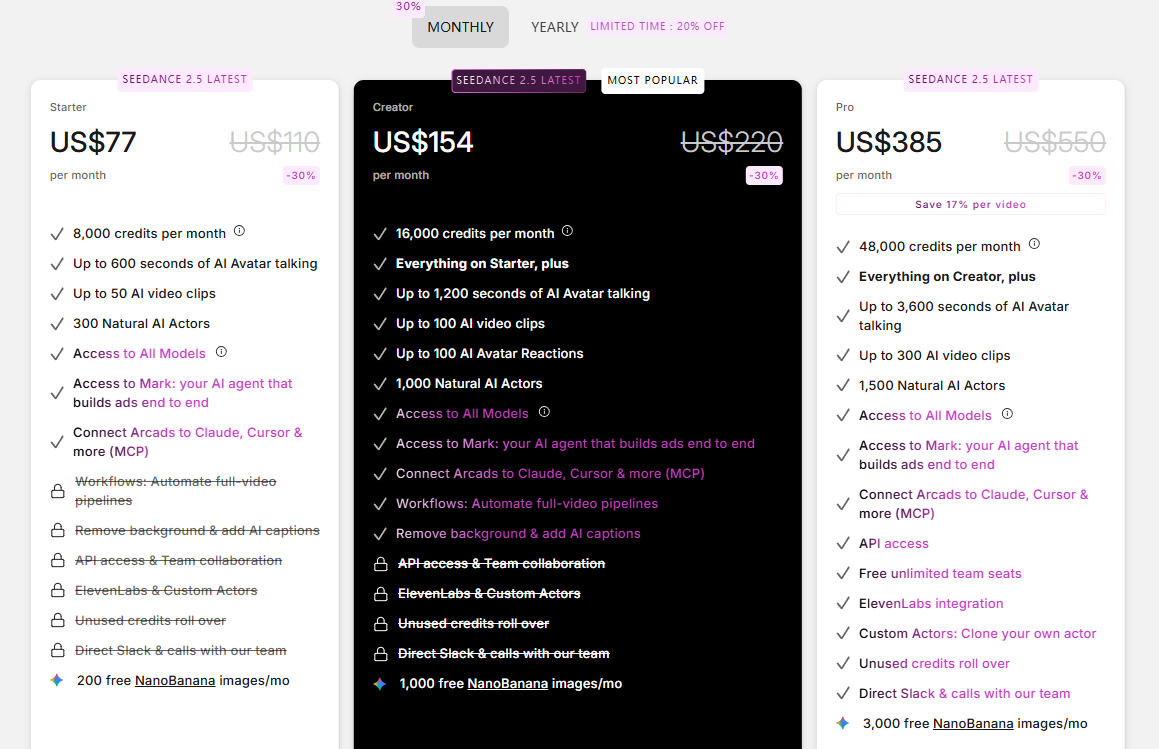
These screenshots were captured inside the same Arcads subscription interface. Use the switch to inspect the plan names, visible limits, locked features, and promotion attached to each billing view.
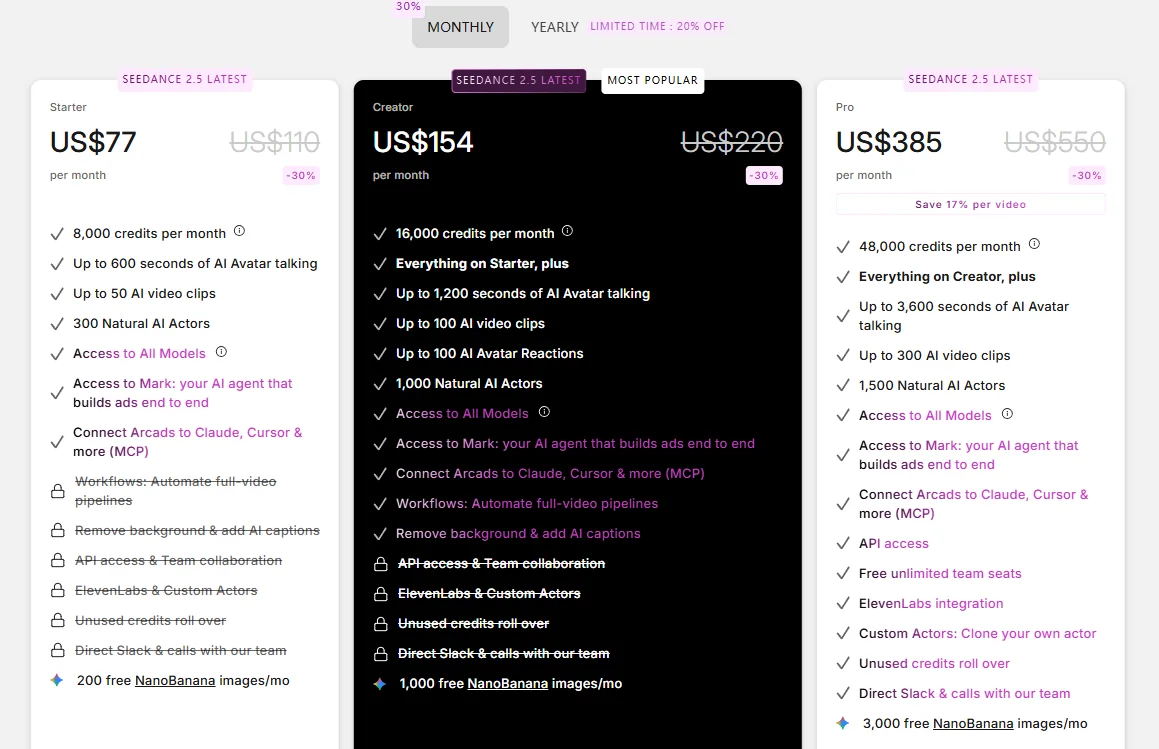
Monthly view captured August 17, 2026. Starter, Creator, and Pro show a 30% promotion: $77, $154, and $385 per month.
Primary capture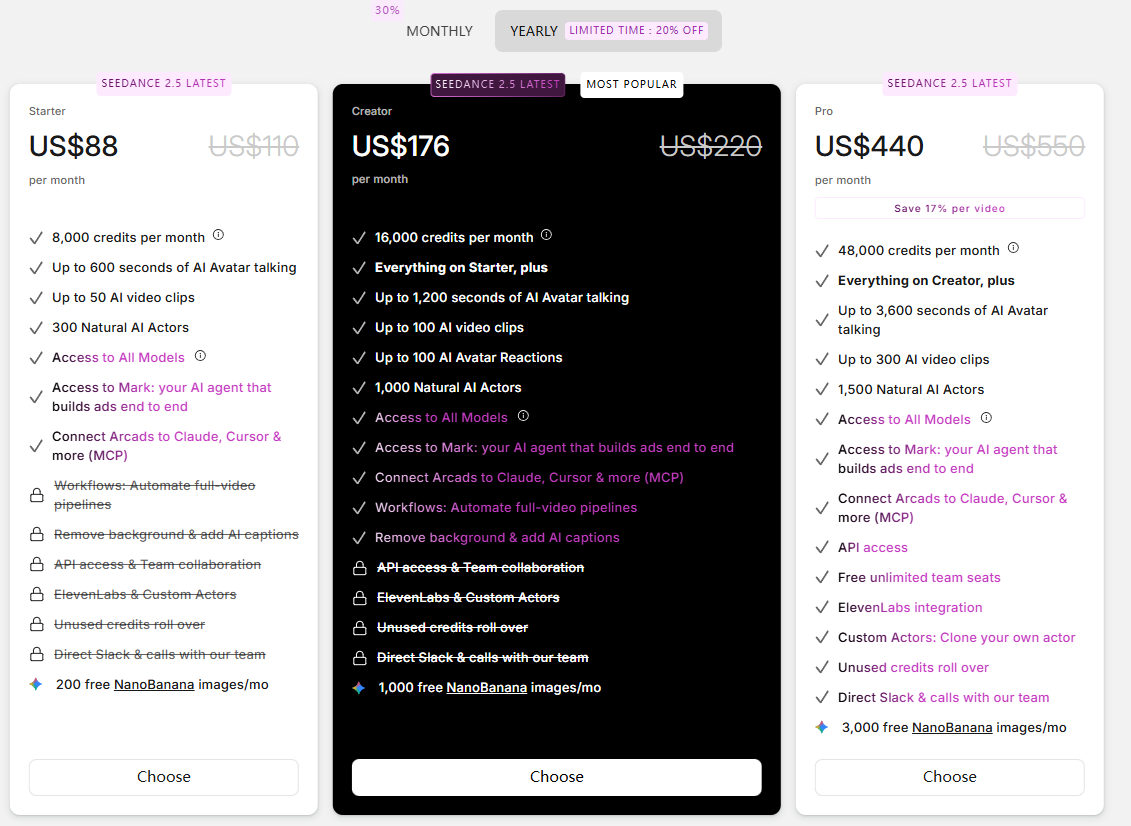
Yearly view captured August 18, 2026. It shows a 20% promotion and per-month figures of $88, $176, and $440. The screenshot does not show the full annual total or exact charge timing.
Primary captureWhat each Arcads plan buys.
- 8,000 credits
- Up to 600 seconds of AI Avatar talking
- Up to 50 AI video clips
- 300 Natural AI Actors
- All models, Mark agent, and MCP access
- 200 free NanoBanana images/month
Best fit: one marketer validating whether Arcads output works for a real campaign.
- 16,000 credits
- Up to 1,200 talking seconds
- Up to 100 video clips and reactions
- 1,000 Natural AI Actors
- Workflows, background removal, captions
- 1,000 free NanoBanana images/month
Best fit: a repeat user who has already proven that frequent script and actor variation saves production time.
- 48,000 credits
- Up to 3,600 talking seconds
- Up to 300 video clips
- 1,500 Natural AI Actors
- API, unlimited team seats, ElevenLabs
- Custom actors, rollover, Slack and calls
Best fit: an agency or production operation that needs collaboration, automation, actor cloning, and predictable monthly volume.
Do not buy Creator because it is marked “Most Popular.” Buy it only when your expected workload exceeds Starter and the additional workflow tools save more than the extra $77 per month. Pro is a capability purchase, not merely a volume discount.
The headline cost per clip is only the best-case floor.
Those numbers assume you use the full clip allowance and every clip is valuable. Real cost rises when a generation is rejected, a model consumes more credits, captions or translation use additional credits, or the output requires another editor.
For Talking Actor generation, Arcads' official help center lists 800 credits per minute, per actor, with duration rounded up. That means a short single-actor clip can consume the full one-minute unit. A two-actor video multiplies the charge by two. Arcads' own example says a 1 minute 45 second video with two actors rounds to two minutes and consumes 3,200 credits.
Not every generation costs the same.
| Action | Official credit signal | Buyer implication |
|---|---|---|
| Talking Actor | 800 credits per minute, per actor; rounded up | Short and multi-actor scripts can be less credit-efficient than expected. |
| Video models | Ranges from 24–304 for Grok to 320–1,200 for Sora 2 Pro; Seedance 1080p can reach 1,620 | The same monthly credit balance produces very different output counts by model. |
| Product showcase preset | 800 credits | One preset can equal a Talking Actor minute. |
| Add captions | 80 credits | Finishing operations also consume the pool. |
| Translate video | 240 credits | Localization volume needs a separate allowance. |
| Hook repurposer | 800 credits | Creative variation is not free even when the original video already exists. |
This excludes human editing, media spend, staff time, and unused credits. Use it to compare workflows, not to predict ROAS.
Arcads appears capable, but the buyer experience is inconsistent.
Where sources broadly agree
“quality of production, with the right prompts”
“The video generated look blurry and low quality”
Why these excerpts: they isolate the same buying variable from opposite experiences, namely output quality. They are not presented as representative of every Arcads customer.
Read this before using the first credit.
A cash refund may apply when
- The billing-period charge is within 30 days and zero credits were used.
- A first charge was accidental, requested within 24 hours, with zero credits used.
- Arcads charged you after a documented cancellation.
A refund normally does not apply when
- A completed output works technically but you dislike the creative result.
- Any credits were already used in the current billing period.
- A credit reimbursement request arrives more than 30 days after the failed generation.
Confirmed platform failures may qualify for credit reimbursement rather than cash. Save generation IDs, screenshots, error messages, and support correspondence when a job fails.
Make the first credit spend answer a buying question.
| Before generating | During generation | After export |
|---|---|---|
| Pick one offer, one audience, one CTA, and one vertical format. | Capture the credit estimate or model setting before each generation. | Mark each output as launchable, editable, or rejected. |
| Shortlist three actors that plausibly match the product category. | Do not change script and actor at the same time unless you record why. | Calculate software cost per launchable ad, not per generated clip. |
| Write the rejection criteria before seeing the outputs. | Save failures, glitches, and support messages as evidence. | Upgrade only if the usable rate justifies Creator or Pro capacity. |
Do not let an AI actor invent customer experience.
Creator tutorials often demonstrate first-person testimonial scripts. That format can be persuasive, but it can also become deceptive when a synthetic presenter implies personal product use or repeats unsupported health and performance claims.
- Use competitor ads for structure research, not copied scripts or claims.
- Do not make a synthetic actor claim they personally used the product.
- Keep evidence for health, earnings, and performance statements.
- Disclose dramatization or AI generation where law or platform policy requires it.
- Verify names, numbers, pronunciation, captions, and the final CTA before launch.
- Keep documented customer consent when adapting a real testimonial.
Start with Starter only after preparing one controlled test. Use a final script, shortlist actors first, and record every rejected generation. Upgrade only when the workflow produces enough launchable ads to justify the higher monthly commitment.
Affiliate disclosure: we may earn a commission from the Arcads link at no added cost to you.
Two screenshots will answer the remaining purchase questions.
These are editorial placeholders for the research build and should be replaced before public launch. The complete collection checklist is stored in the project documentation.